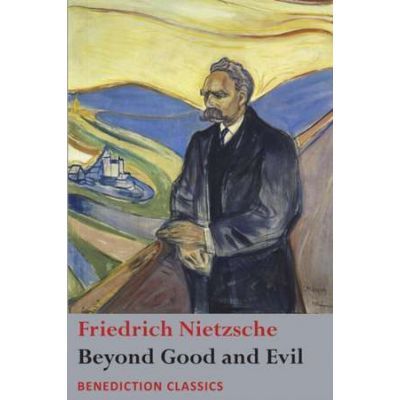
Beyond Good and Evil - Friedrich Nietzsche
- Editura
- Oxford University Press
- An apariție
- 2018
- ISBN
- 9781781399491
44,91 lei
Prețul include TVA.
Stoc epuizat
Anunță-mă când revine în stoc
- Verificare colet la livrare
- Retur în 14 zile
- Plată securizată
Despre carte
Beyond Good and Evil is a comprehensive overview of Nietzsche's mature philosophy. The book consists of 296 aphorisms, ranging in length from a few sentences to a few pages. These aphorisms are grouped thematically into nine different chapters and are bookended by a preface and a poem. While each aphorism can stand on its own, there is also something of a linear progression between aphorisms within chapters and from one chapter to another. Nonetheless, each aphorism presents a distinctive point of view, and even the individual chapter summaries omit a great deal. The preface accuses philosophers of dogmatism, and the first chapter explores this claim. Every great philosophy, Nietzsche asserts, is little more than the personal confession. Philosophers build up complex systems of thought to justify their own assumptions and prejudices. If we can dig these out, we can see what these philosophers value most deeply, and so gain insight into their character. Nietzsche contrasts their dogmatism with the "free spirit" that is not caught up in a particular point of view. He hopes the philosophers of the future will be characterized by such an experimental method, willing to try out any hypothesis, and follow any argument all the way to its conclusion. After a discussion of the religious spirit, which he claims is a kind of dogmatism, Nietzsche embarks on a series of epigrams, most of which highlight our bizarre psychological make-up. Next, he looks at the long history of moral systems as a set of different attempts at self- overcoming. He speaks out strongly against the morality of the "herd" that encourages a dull mediocrity in all. He finds such a mediocrity in modern scholarship, which is overly concerned with digging up dry, dull facts. Nietzsche's ideal philosopher creates meaning and values, and does not simply deal with empty facts. Nietzsche asserts that there is an "order of rank" according to which the spiritual strength of all people can be measured. Because of this difference between people, it would be absurd to apply one moral code to all people. Nietzsche suggests that the strongest people are marked by a cruelty to themselves, according to which they mercilessly expose their every prejudice and assumption in order to dig more deeply into themselves. At bottom, however, everyone has prejudices. To prove this point, Nietzsche launches an eight-page tirade against women. Next, he addresses the question of nationalities and nationalism, drawing on a kind of Lamarckism that sees different nationalities or "races" as inherently having certain characteristics. Among other things, Nietzsche attacks anti- Semitism, criticizes the English, and advances the concept of the "good European," who rises above nationalist sentiment to find true individuality. The final chapter presents Nietzsche's conception of "what is noble" a solitary, suffering soul, who has risen so far above the common rabble as to be unrecognizable and totally misunderstood by them. He closes the book with a weak poem about such a noble soul sitting on a mountaintop wishing he had more friends.
Detalii
- Autor
- Friedrich Nietzsche
- An apariție
- 2018
- Numar pagini
- 122
- ISBN
- 9781781399491
Recenzii
Recenzii
Acest produs nu are inca recenzii. Fii primul care adauga o recenzie.
Doar utilizatorii inregistrati pot scrie recenzii. Va rugam sa va autentificati sau sa creati un cont
Întrebări frecvente
- Cât costă livrarea?
- Transportul este gratuit la comenzile de peste 300 lei.
- Pot verifica coletul la livrare?
- Da, coletul se poate deschide la livrare.
- Pot returna cartea?
- Da, în termen de 14 zile de la primire.
Intrebari si raspunsuri
Lasa o intrebare si in cel mai scurt timp vei primi un raspuns
Din aceeași categorie: Filosofie
Vezi toate

Stoc epuizat


Stoc epuizat